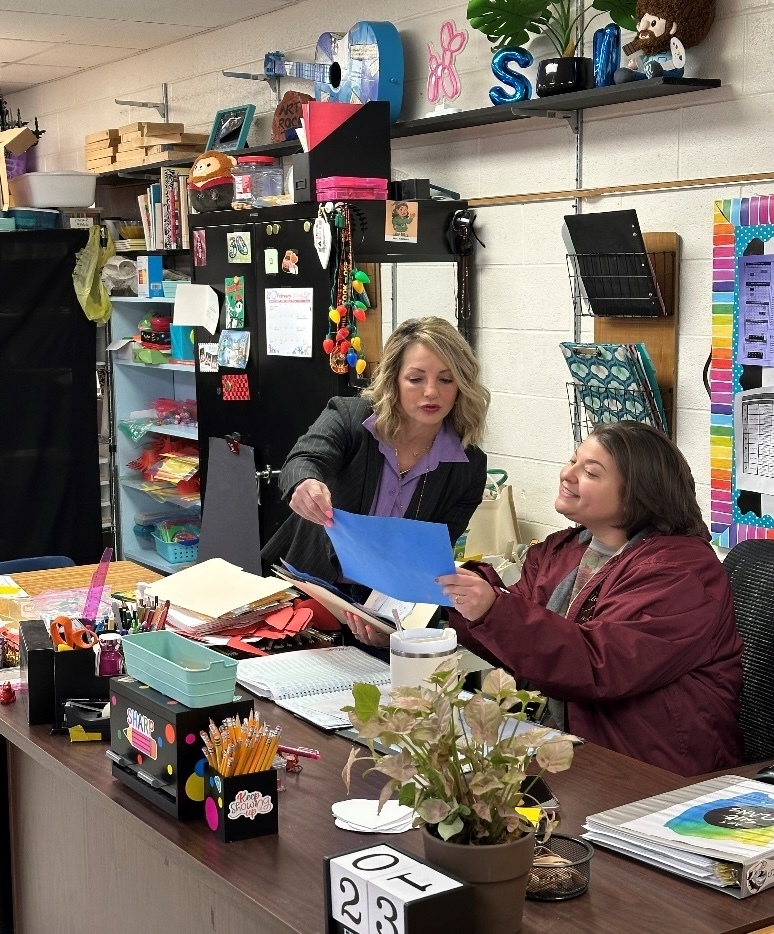


Moore Superintendent Robert Romines discusses how his district created a successful teacher induction program that has led to stronger teacher recruitment and retention.
Moore Public Schools has defined my life’s journey. I received my entire K-12 education in Moore, and I come from a long line of Moore educators with both my grandfather and father serving in our public school system. Naturally, after I completed a bachelor’s degree in education at the University of Central Oklahoma, I returned to Moore to become a teacher myself.
Later, after serving in various leadership roles in the district, I became Superintendent in 2013. That year, our community experienced one of the worst natural disasters in Oklahoma’s history. An EF5 tornado hit our district, destroying more than 1,000 structures, leveling two of our schools, and tragically taking the lives of 26 people in the area, including seven Moore students. It was remarkable how the community responded, coming together to rebuild in the aftermath of the deadly storm.
Today our community is facing a different challenge. One that is less visible than the destruction from a tornado but nonetheless poses a serious threat to the future of our schools. The issue is that fewer individuals are choosing to enter the teaching profession every year. This problem is not just Moore’s, but it is a statewide issue.
State data show just how sharply the teacher pipeline has weakened. For example, Oklahoma reported 1,494 emergency certified teachers this school year. When I started as superintendent in 2013, the state had only 189 emergency certified teachers staffing its classrooms statewide. Adding to this challenge, Oklahoma’s universities graduated just 1,037 new teachers in 2024, but in 2013, they produced over 1,700 new teachers.
Teachers have also been leaving the profession at higher rates than in the past. Until recently, we had the same issue at Moore. Teacher retention rates were on the decline, with many teachers leaving before the five-year mark. Replacing our teachers was difficult. We previously had an average of 30 teaching positions or more left open during the first week of school for over five consecutive years.
When we asked departing teachers why they chose to leave, many said that they felt unprepared, especially in foundational teaching methodologies and approaches to classroom management. In other words, they had the heart to teach but were not fully prepared for the demands of the role.
My team and I routinely found ourselves agonizing over losing some of our most promising teachers and then struggling to replace them. We know that teachers are the lifeblood of our schools and greatly influence students’ academic and life outcomes. So, we decided to take action by creating a district teacher induction model that has since helped us recruit and retain teachers. The results have been striking. At the beginning of the 2025-26 school year, we filled all but two special education positions out of 1,500-plus teaching positions at our 35 school sites. In my 12 years as superintendent, this had not happened before.
Moore’s Teacher Induction Program
Moore’s comprehensive teacher development model is grounded in the idea that new teachers are most at risk of leaving the profession, and therefore, need the most support early on in their careers. Meta-analytic research indicates that comprehensive programs of this nature can improve both teacher retention and student achievement. As defined in the scholarly literature, comprehensive induction programs tend to consist of routine mentoring, instruction-focused professional development, opportunities for observation, and feedback on teaching.
Starting in 2019, we built our own induction program at the elementary school level with a team of instructional coaches, called Instructional Resource Specialists. These coaches were selected because they had a proven track record of high-performance in the district. Through one-to-one coaching, we focused on helping our new educators identify and address pedagogical gaps and learn critical classroom management techniques. The early program was successful in supporting teachers who participated, so we quickly decided to expand our efforts to include middle and high school teachers as well.
Today, all Moore teachers who are new to the profession are automatically enrolled in Moore’s teacher induction program during their first year in the classroom. We have enhanced the program over time, adding support elements that have strengthened the experience for teachers. Each new teacher at Moore now receives the following integrated supports:
-
One-on-one coaching from an Instructional Resource Specialist
-
Mentoring from an assigned district mentor with classroom experience
-
Peer observations and learning walks
-
Monthly teacher training sessions provided through a district-designed teacher academy
Our program represents a considerable investment of time and resources. We now have seven full-time Instructional Resource Specialists who provide support to our new teachers. Because these coaches were formerly leading their own classrooms, we hired new teachers to replace those who joined the resource team, which was a tradeoff but one that was worth it.
Moore’s induction program has been critical to teacher development and retention. Without it, our new teachers had reported feeling isolated, lacking quality professional learning, and being unable to meet the demands of the classroom. Those without formal training from a college of education were especially likely to say that they were struggling.
Because of our induction program, we reap cost savings by developing long-term educators who do not have to be replaced as frequently as in the past. We have seen increased student achievement and strong professional growth. Our teacher retention rate has risen to 86%, which is well above the state average of 71%. For Moore, that means stable classrooms and positive student outcomes. Table 1 presents the total number of teachers who have participated in our induction program over the past three school years.
When our Deputy Superintendent of Human Resources, Michelle McNear, goes to teacher job fairs, new graduates always ask her, “How will you support me as a new teacher?” Now, our district has a concrete answer to that question. Because we have a comprehensive induction program in place, new teachers know that they will be supported in Moore.
Looking ahead, we plan to expand the induction program by supporting new teachers for three years and by providing targeted coaching and professional learning for any Moore educator who needs it.
Expanding Induction Programs Statewide
A small number of teachers retiring or leaving the district is normal in any district. High teacher turnover rates, however, are a considerable drain on school resources. From interviewing to onboarding to assisting new teachers as they settle into their classroom, onboarding new teachers takes significant time and resources. Too many of Oklahoma’s districts are dealing with high turnover, and as a result, are stuck in a cycle of continuous onboarding of new teaching staff. If Oklahoma’s districts can keep new teachers engaged and feeling supported, they will see retention rates increase, enabling them to devote more energy to teaching and learning.
At Moore Public Schools, we are bringing in teachers and developing them into professional educators through our comprehensive induction program. It has taken time to refine the program and it has certainly required dedicated resources. But we have seen a clear return. School districts around the state should consider investing in new teacher induction programs of their own. Moore stands ready to partner on any such initiatives.
Author Bio
Dr. Robert Romines is the Superintendent of Moore Public Schools.