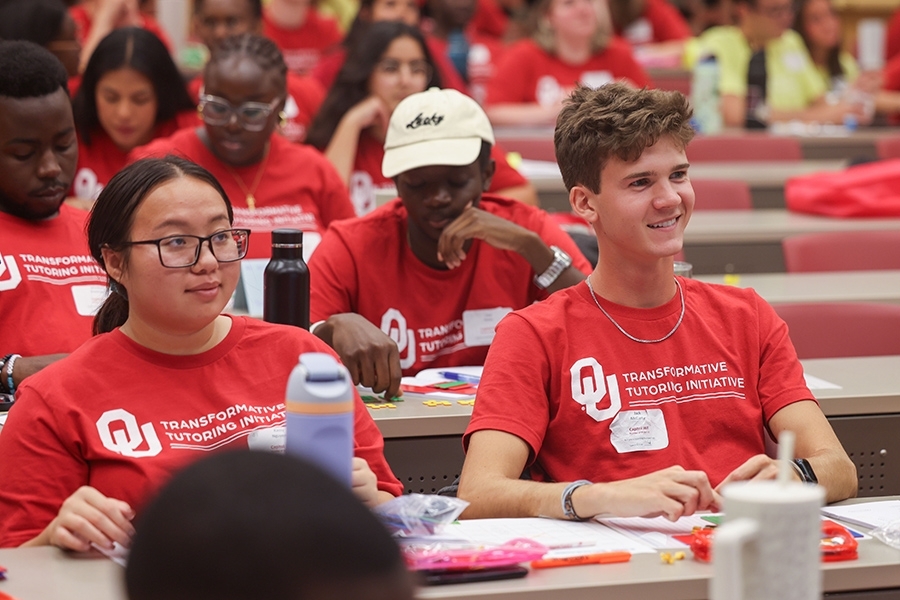

This article presents the effects of the Transformative Tutoring Initiative – a university-led high impact tutoring model at the University of Oklahoma.
Performance in high school mathematics is predictive of students’ academic, post-secondary, and workforce outcomes. Yet, a substantial share of students enter high school scoring below proficiency in mathematics, a problem that has worsened in the wake of the COVID-19 pandemic. In response, many school districts across the country have invested in high-impact tutoring, which is frequent, small-group instruction embedded during the school day. High impact tutoring has a robust evidence base supporting its use, but there have been few studies testing whether high impact tutoring is effective during high school.
In this study, my colleagues and I tested the effects of a university-led model of high impact tutoring with university students trained to tutor low performing high school students. For the study, we used a gold-standard randomized controlled trial design at seven high schools over a three-year period. In the treatment group, over 500 ninth-grade students participated in high impact tutoring (i.e., groups of 2:1 or 3:1) while the comparison group of more than 400 ninth-grade students attended a remedial mathematics course with a teacher. Both groups essentially received the same amount of instructional time in math. Results indicated that students who received high-impact tutoring showed greater academic growth (about an additional half-year of learning) compared to their peers enrolled in the remedial mathematics class with a classroom teacher.
The Transformative Tutoring Initiative
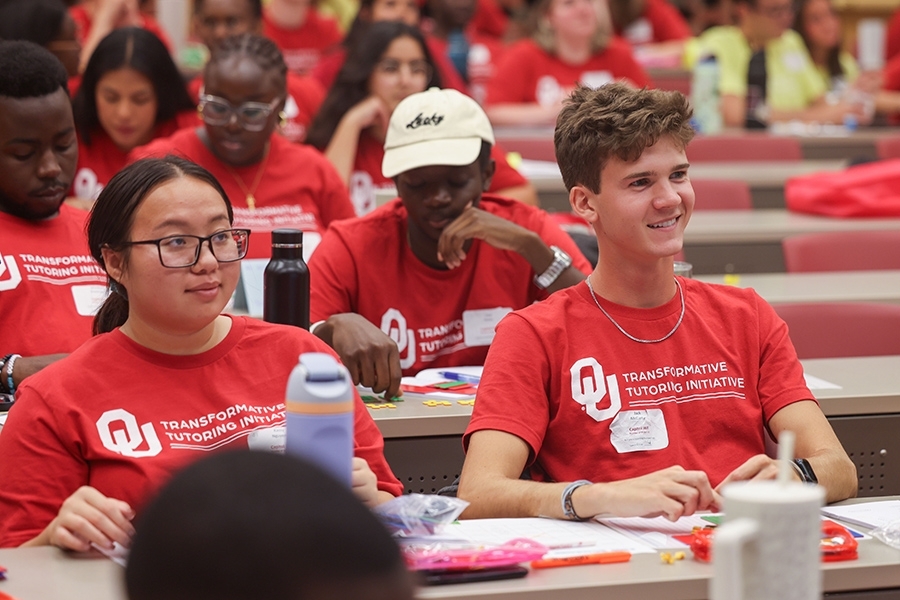
Developed at the University of Oklahoma, the Transformative Tutoring Initiative is a university-led high-impact tutoring model designed to build pre-Algebra skills among low-achieving ninth-grade students. The program was developed and implemented by faculty and staff at the University of Oklahoma, who provided structured curriculum materials, intensive tutor training, as well as ongoing coaching of the tutors. Tutoring was embedded into class schedules within the school day to ensure student participation as well as alignment with classroom instruction.
At seven high schools, students were randomly assigned to either a treatment group receiving high impact tutoring or to a control group receiving teacher-led instruction in a remedial mathematics class. Both groups had largely similar class sizes, instructional time, and course content throughout the year. However, in the high impact tutoring treatment group, trained university students worked as tutors in small groups of two to three students three times per week.
One of the hallmarks of the program is the use of university students as tutors. University students often accept part-time employment, possess foundational high school mathematics skills, and are near peers who can become positive role models for academically struggling high school students. An additional benefit of using university tutors is that it generates a two-for-one investment where university students receive financial support and work experience while high school students have an opportunity to develop critical academic skills.
Table 1 presents the characteristics of tutors who participated in the program, all of which were from the University of Oklahoma. The Transformative Tutoring Director Cristina Moershel and her team carefully selected, compensated, trained, and monitored tutors throughout the duration of the study.
Data Sources and Methods
This study followed three cohorts of ninth-grade students from 2021 to 2024 across seven Oklahoma high schools that included a mix of rural, urban, and suburban high school settings. Eligible students for the study were generally identified as low or low-average performers based on eighth-grade NWEA MAP scores. Among high school students in the study, average baseline achievement at the start of fall was at the 25th percentile in math achievement, indicating that participating students needed considerable remedial support.
These students were first randomly assigned to remedial mathematics class sections, and then those sections were randomly designated as either high-impact tutoring (treatment) or standard teacher-led instruction (control). All students were concurrently enrolled in Algebra I, ensuring comparable instructional exposure across groups and making sure that students remained on track for graduation.
The sample expanded each year (223 students in Year 1, 370 in Year 2, and 520 in Year 3), with low overall attrition (6–7%) and no meaningful attrition differences between treatment and control groups. To estimate the effects of the initiative, students were randomly assigned to either a treatment group receiving high impact tutoring or to a control group receiving standard teacher-led instruction in a remedial mathematics class. Both groups had similar class sizes, instructional time, and remedial course content throughout the year. In other words, the primary difference between them was the mode of instruction (high impact tutoring vs. teacher-led instruction).
Student outcomes included mathematics achievement, measured by NWEA MAP and grade point average, supplemented by administrative data on demographics and detailed records of tutoring participation. The analytic approach estimated both intent-to-treat (ITT) and treatment-on-the-treated (TOT) effects using regression models that controlled for baseline achievement and student characteristics, with school and cohort fixed effects and standard errors clustered at the school level. Additional analyses examined heterogeneity in treatment effects by student subgroups (e.g., FRL status, race/ethnicity, ELL, and special education) and by tutoring dosage, including experimental variation in tutor-to-student ratios (2:1 versus 3:1) that we introduced during the third year of the study.
Results
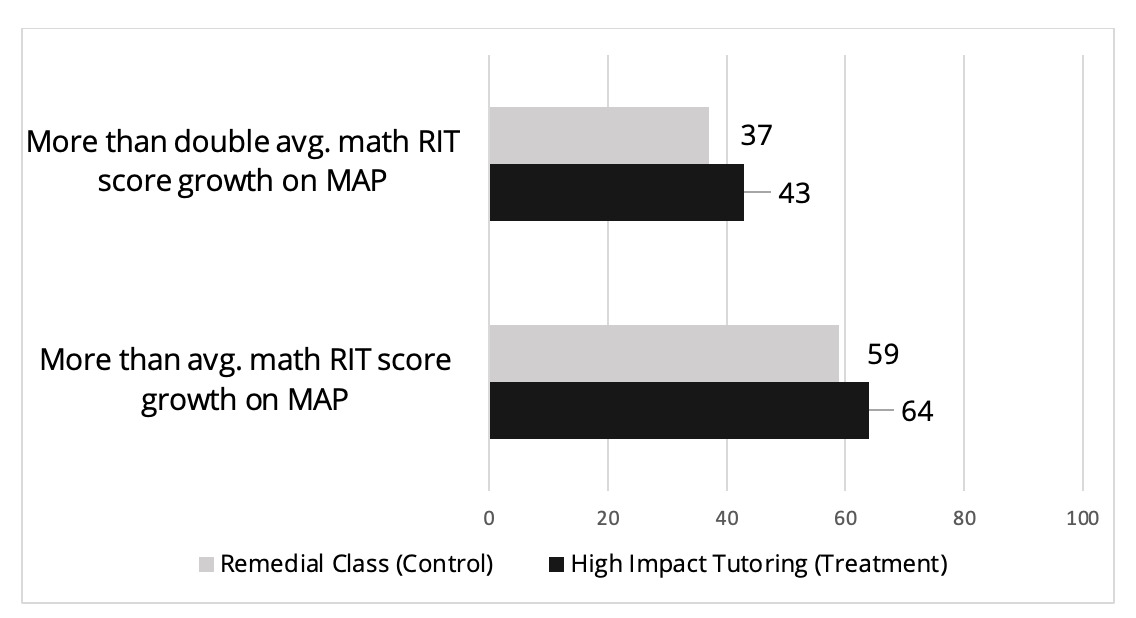
Over the three years of the study, overall results showed that students receiving high-impact tutoring had stronger gains in mathematics than their peers in the control group, but both groups exceeded national norms for expected academic growth. On the NWEA MAP test in mathematics, tutored students in the treatment group gained 6.27 RIT points while students receiving teacher-led instruction in the control group gained 5.21 points, relative to an expected growth benchmark of 3.6 points for ninth grade students.
In Figure 1, descriptive findings show gains in both groups. A larger share of tutored students met or exceeded expected growth benchmarks, with 64% surpassing expected growth (versus 59% in the control group) and 43% achieving more than double expected growth (versus 37% in the control group).
Causal estimates from regression models indicated that high impact tutoring positively affected students’ math achievement, with ITT and TOT effects of approximately 1.6 RIT points (p < .05), equivalent to nearly half a year of additional learning compared to the control group receiving teacher-led instruction. Nonetheless, there were no statistically significant differences between the two groups of students in grade point averages. My colleagues and I theorized that this was because grade point average may simply be a less objective measure of academic growth, being influenced by variability in grading standards, subjectivity in assessments, school norms, and other non-academic factors.
.png)
In the third year of the study, students within the high impact tutoring treatment group were also randomized to 2:1 and 3:1 group sizes. Our intention was to see if group sizes could be expanded without reducing impact. If so, our program could reach more students. We observed no advantage for the smaller 2:1 groups, meaning that we could move to 3:1 groups sizes without diminishing effectiveness.
In the study, subgroup analyses showed largely consistent effects across student populations, with the exception of students eligible for free or reduced-price lunch, who experienced modestly larger gains than their peers.
Cost Effectiveness
It is important to note that high impact tutoring programs are relatively expensive. To make high impact tutoring truly successful, substantial financial and human resources are required that include tutor training, school site coordination, transportation costs, and compensation for tutors and administrative staff.
From a cost-effectiveness perspective, the Transformative Tutoring Initiative at OU produced a moderate effect size on student achievement, but at a relatively high cost of $5,207 per student. The cost of high impact tutoring was mostly attributable to tutor compensation, resulting in an additional cost of $4,740 over the control condition. Nevertheless, we found that the cost of high impact tutoring could be reduced substantially (to about $3,495 per student) by using 3:1 tutoring groups, which we found did not reduce effectiveness.
Conclusion
This study contributes to a large body of evidence demonstrating that high-impact tutoring can improve student achievement. It also addresses an important gap in understanding about these programs. By comparing tutoring to a control condition that provided the same amount of additional instructional time, the study isolates the added value of high impact tutoring beyond simply increasing instructional time. Results from three cohorts of ninth-grade students demonstrate that high impact tutoring produced a meaningful gain of roughly half a year of additional learning.
It is also important to note that high impact tutoring requires substantial financial and human resource investments to pull off. Such high costs can limit the reach and sustainability of high impact tutoring. The findings from this study show that increasing tutor-to-student ratios from 2:1 to 3:1 does not diminish effectiveness, offering a lever for improving cost efficiency and extending the reach of tutoring with existing resources.
At the same time, the study highlights important limitations and practical considerations for scaling high-impact tutoring. Results are drawn from a specific set of schools in Oklahoma, many facing teacher shortages, which may limit the generalizability of our findings to other school settings. Schools with more experience teaching staff might not benefit as much from high impact tutoring.
From a policy perspective, the findings also underscore the tradeoffs between effectiveness and cost. While high impact tutoring yields positive effects, it is substantially more expensive than remedial coursework, raising questions about scalability. University-led tutoring models are a promising approach to expanding capacity by leveraging near-peer tutors, but they require strong training, coordination, and continuous improvement systems to work well. Overall, the study suggests that university-led high-impact tutoring can be effective but is a resource-intensive intervention. Future work should continue exploring cost-effective models, implementation strategies, and mechanisms for sustaining program quality at scale.
Policy Recommendations
1. Prioritize High-Impact Tutoring for Struggling High School Students
When resources are available for high impact tutoring, school districts should target high-impact tutoring toward low-performing ninth-grade students, particularly in gateway courses, such as Algebra I, where even modest gains can influence academic trajectories and graduation outcomes.
2. Expanded Tutoring Group Sizes to Improve Cost-Effectiveness
At the high school level, high impact tutoring program leaders should consider adopting 3:1 student–tutor ratios rather than relying on smaller group sizes. Doing so can expand the reach of tutoring by reducing per-student costs and without lessening academic gains. Programs might also explore whether 4:1 ratios are workable.
3. Leverage University Partnerships to Scale Tutoring
Policymakers should consider investing in university-led tutoring models that hire undergraduate and graduate students to serve as tutors. An advantage of using university students as tutors is that it creates a dual return on investment where university students gain financial support and experience and struggling high school students benefit from personalized instruction.
4. Stress Continuous Improvement and Implementation Quality
High impact tutoring should make ongoing refinements to tutor training, coaching, and instruction, knowing that program effectiveness must get better each year over time. Attention should also be given to implementation quality as programs scale. Strong oversight and monitoring are key in this respect.
Funding Acknowledgment
The authors wish to acknowledge the generous philanthropic support given from the Randall and Lenise Stephenson Family Foundation, which made this study and the Transformative Tutoring Initiative possible.
Author Bio
Daniel Hamlin is Presidential Professor of Education Policy at the University of Oklahoma. He is also currently serving as Oklahoma Secretary of Education.
Corey Peltier is an Associate Professor of Special Education at the University of Oklahoma
Stacy Reeder is Dean of the College of Education and Professor of Mathematics Education at the University of Oklahoma.