

Education policy has been central to Oklahoma’s 2026 legislative session. Several key education bills bring major changes in the areas of early literacy, school calendars, educational choice, and work-based learning. Understanding whether these legislative actions reflect the priorities of Oklahomans is critical. Now in its third year, the Oklahoma Education Poll provides one of the state’s most credible snapshots of public sentiment on education policy.
This year’s poll, fielded in early March of 2026, contains a random sample of 1,165 Oklahomans from across the state. Results have a margin of error of less than +/-3 percentage points at a 95% confidence level, which is similar to that of national Gallup polls. To account for potential sampling bias, survey data are weighted to be representative of state population characteristics. For more details on the survey design, see the Poll Design and Methods section below. From this year’s 2026 poll, overall results offer suggestive evidence that Oklahomans continue to desire substantive improvements in the public education system and are open to a range of policy reforms to accomplish that goal.
School and State Grades
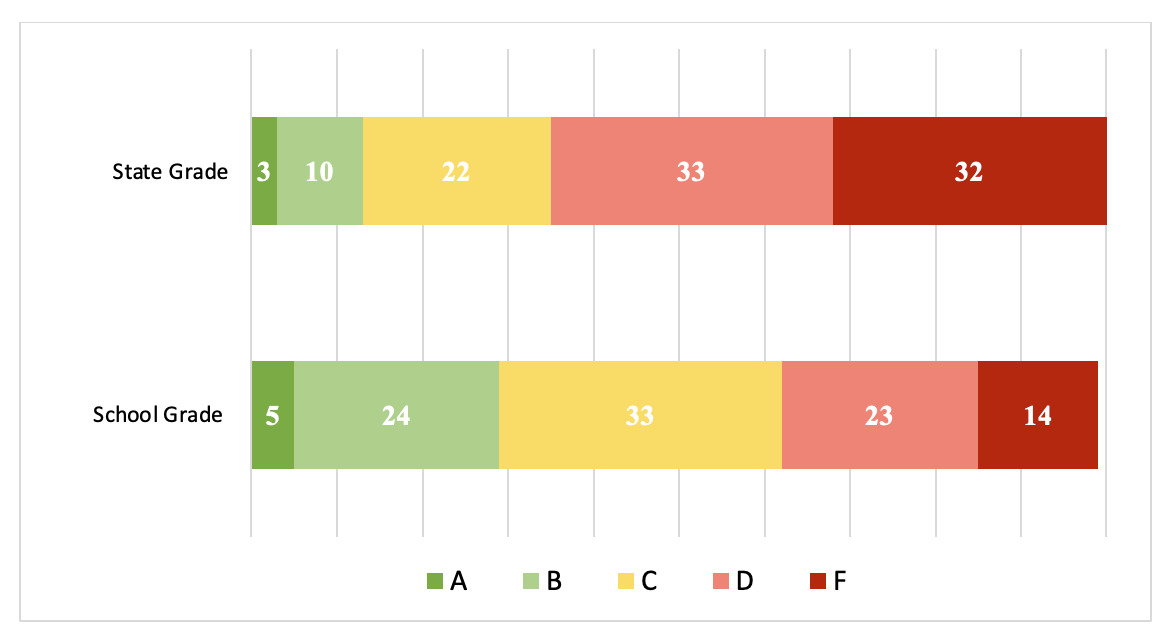
In Oklahoma, the state gives schools grades that reflect academic achievement levels and growth, graduation rates, and post-secondary opportunities (e.g., Advanced Placement courses offered). In the 2026 poll, respondents were asked what grade they would give public schools in their community. They were also asked what grade they would give the state in managing Oklahoma’s K-12 education system. Results indicate that the respondents give either poor or mediocre ratings not only to schools in their community but also in evaluating the state’s management of the K-12 education system.
In Figure 1, approximately 29% of respondents give their local schools an A or B grade, which was down from 41% of respondents giving an A or B grade to their schools in the 2024 Oklahoma Education Poll. Only 13% of respondents give the state an A or B grade this year. These marks were down from 22% giving A or B grades to the state in 2024. For local schools, a C grade is most common, but a D grade is most frequently given to the state in managing the education system. These grades are slightly lower than those reported in national surveys (Note. In national polls, a B grade is most common when respondents assess their local schools).
.png)
Funding for Schools and Teachers
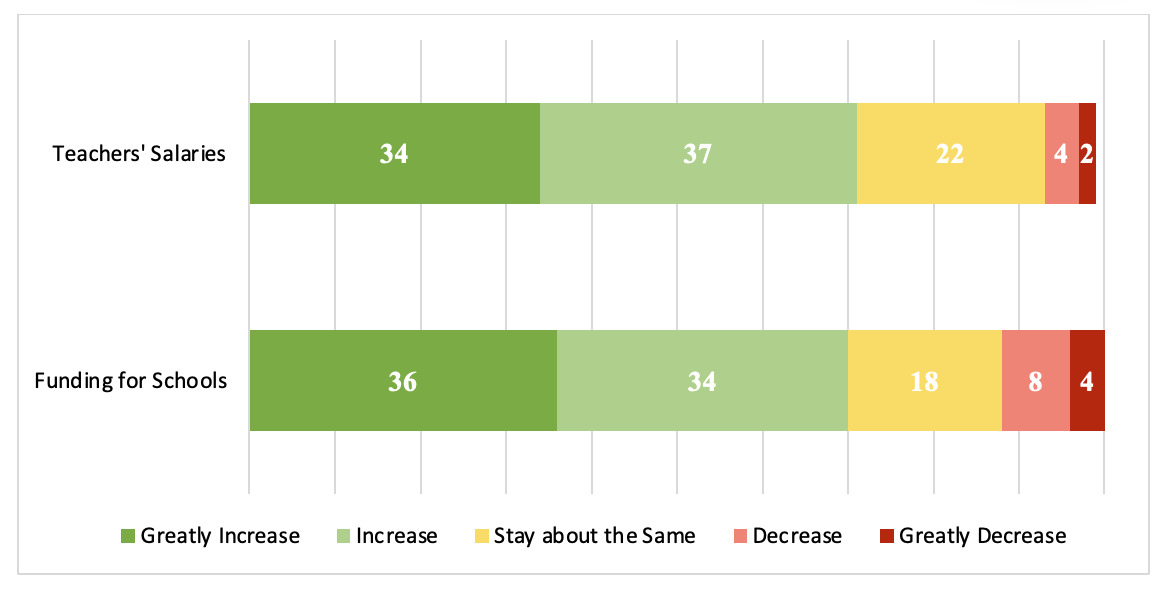
In the 2026 poll, respondents were told that public school teachers in Oklahoma are paid an average of about $60,000 a year. They were then asked whether they thought teachers’ salaries should increase, decrease, or stay about the same. Figure 2 indicates strong support for increasing teachers’ salaries with 71% indicating “Greatly Increase” or “Increase”.
Respondents were also informed that about $12,600 per child was being spent on education in Oklahoma’s public schools each year. They were then asked whether government funding for public schools should increase, decrease, or stay about the same. Figure 2 suggests support for raising funding for public schools (70%) in general.
.png)
Oklahoman’s Views on Major Education Policy Issues
In Table 1, Oklahoman’s views on education policy issues are presented for the annual 2024, 2025, and 2026 Oklahoma Education Polls. During the 2026 legislative session, the House and Senate introduced comprehensive packages designed to enhance Oklahoma’s Strong Readers Act with both bills including a third-grade retention provision for students who are not reading on grade level by the end of third grade. In the 2026 poll, respondents were asked what they thought of such a mandate. Seventy percent say that they back a third-grade retention mandate that would require schools to retain students who are not reading on grade-level at the end of third grade. Only 23% oppose this mandate.
Along with early literacy policy, lawmakers are considering changes to Oklahoma’s school calendar. Currently, the state’s students attend school in-person for an average of approximately 159 days per year. Legislation introduced by Representative Rob Hall increases the minimum number of in-person student days to 166 days, aligning the state more closely with national norms. In the poll, 63% of respondents report that they support a standard 180-day in-person school year.
Last year lawmakers passed a temporary cell phone ban during the school day. State legislators advanced bills in the House and Senate that would make the state’s temporary bell-to-bell cell phone ban permanent. This legislation seems to be relatively popular. The percentage of respondents who favor such bans on cell phones rose to 64% in 2026 from 60% being in favor in the 2024 and 2025 polls.
In recent years, Oklahoma has been in the national spotlight for its school choice initiatives. Among school choice bills under consideration this session, proposed legislation would provide low-interest loans to public charter schools for capital expenditures, such as the construction and renovation of school facilities. Charter schools presently lack access to local tax revenue that district-run public schools often use to build and upgrade buildings. In the private school choice sector, policymakers are also considering raising the current cap on the individual refundable tax credit to support growing demand for private school choice.
In the poll, respondents were provided with short descriptions of charter schools as well as the state’s individual refundable tax-credit for private school tuition and fees. In all three polls, respondents expressed more support than opposition for charter schools as well as for individual refundable tax-credits for private school tuition and fees. For the first time, respondents were asked this year whether funding for charter schools should be on the same level as that of district-run public schools. Respondents are essentially split on this issue. Forty-four percent oppose charter schools receiving the same level of funding as that of other public schools, compared with 43% in support.
Additional legislation this session aims to expand teacher performance pay opportunities and increase incentives for teachers to obtain National Board Certification. In 2026, respondents were asked whether they supported performance pay for teachers based on their students’ academic growth. A sizable percentage (69%) of respondents support performance pay for teachers based on their students’ academic growth during the school year.
State lawmakers have long debated district consolidation. In Oklahoma, there are over 500 school districts serving approximately 700,000 public school students. The number of districts compared to total students is one of the highest in the nation – a situation that has stirred ongoing debates in rural areas about school district consolidation (i.e., the combining of small districts into one larger district).
In the poll, respondents offered their views on school district consolidation. Approximately 53% say that they support combining small neighboring districts into one larger school district in 2026, which was the same percentage as last year’s poll on this question of consolidation. In small towns and rural areas, 48% of respondents back school district consolidation, whereas 41% oppose it.
Recently, state leaders have begun contemplating potential changes to annual federal testing requirements as the federal government has promised to return education to the states. In the poll, respondents were asked whether they supported or opposed federal state testing requirements in grades 3-8 for the state’s public school students. A large percentage (76%) report that they support annual testing in grades 3-8.
Finally, with strong support from Governor Kevin Stitt, lawmakers are considering a significant governance reform to the position of the State Superintendent of Public Instruction. A joint resolution from the House and Senate would place before the state’s voters the question of whether Oklahoma’s State Superintendent should be appointed by the Governor rather than elected. In the poll, this proposed change is unpopular with only 26% of respondents supporting it.
Partisan Differences on Key Issues
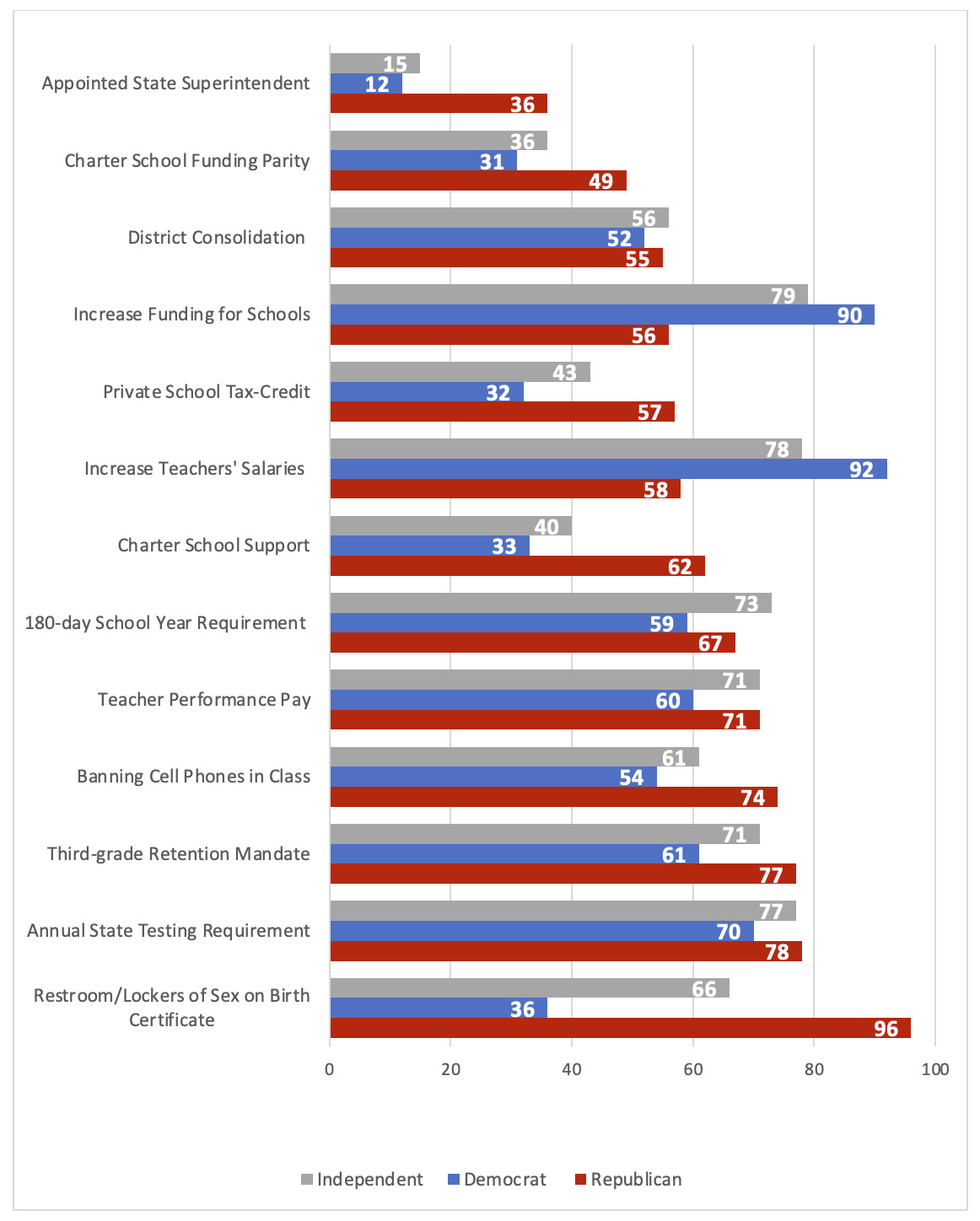
In Figure 3, Democrat and Republican respondents differ on several education issues. As the poll has previously shown, the widest gulf between the two groups is on the state’s law requiring students to use the restroom or locker room that matches the sex listed on students’ birth certificates (96% Republican support vs. 36% Democrat support).
School choice continues to be an area of growing disagreement between Republican and Democrat respondents. Republicans favor individual refundable tax-credits for private school tuition and fees (57%) and charter schools (62%) while expressing comparatively greater support for charter school funding parity (49%). Among Democrats, only 32% support individual refundable tax-credits for private school tuition, 33% support charter schools, and 31% support funding charter schools on the same level as district-run public schools.
In other areas, there is greater overall support for major policy initiatives although the extent of support differs along party lines. For example, 67% of Republicans favor requiring schools to offer a 180-day school year while 59% of Democrats also support a 180-day school year mandate. Majorities of Republicans and Democrats express support for cell phone bans during the school day. Sixty-seven percent of Republicans and 54% of Democrats back banning students from using their cell phones in Oklahoma’s classrooms during the school day.
Democrats and Republicans indicate overall support for increasing teacher compensation with 88% of Democrats and 66% of Republicans supporting raising teachers’ salaries. Additionally, a large share – 79% of Republicans – support teacher performance pay while a sizable majority of Democrats (62%) also support teacher performance pay based on students’ academic growth during the school year.
_indicating_support_by_political_preference.png)
Parent/Guardians’ Views
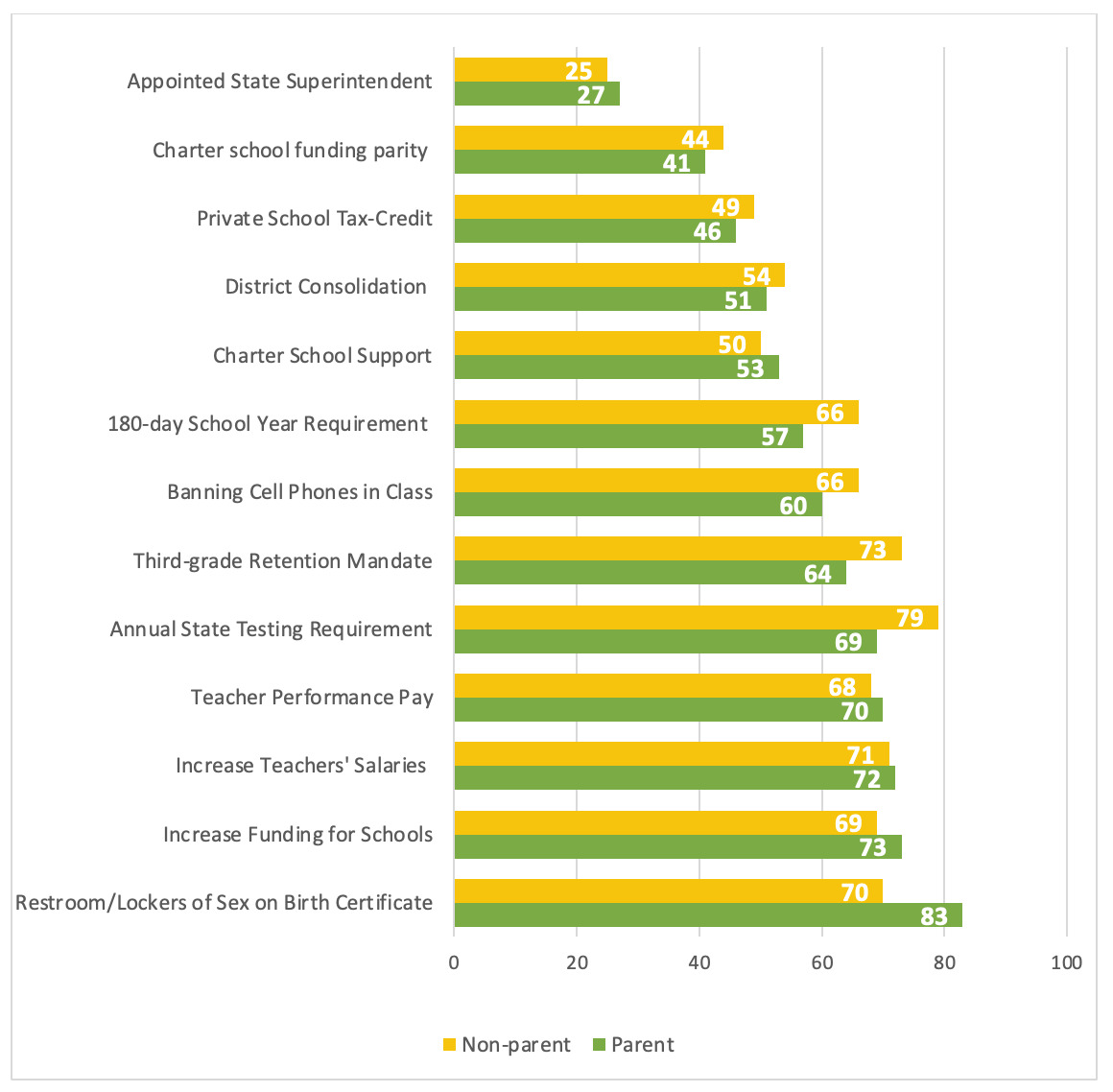
In Figure 4, parent/guardians with children in the K-12 education system are compared to respondents without children in the state’s K-12 education system. With some differences, both groups of respondents express mostly similar views. One of the largest differences is for a 180-day school year requirement, in which 57% of parent/guardians support this mandate while 66% of non-parent/guardians support it. Parent/guardians are much more likely to want to require students to use the restroom or locker rooms that is on their birth certificate compared to non-parent/guardians.
For the two groups, there is more support for school choice policies than opposition to them. However, some observers have argued that school choice in Oklahoma is more relevant for those living in Tulsa and Oklahoma City where there are more private and charter school options available. Among parents/guardians residing in Oklahoma’s two large cities, there is more support for charter schools and the individual refundable tax-credit for private school tuition and fees – 65% of parent/guardians residing in Tulsa and Oklahoma City support charter schools, 55% support charter school funding parity, and 61% support the individual refundable tax-credit for private school tuition and fees.
The strongest consensus between these two groups of respondents is on annual state testing (79% of non-parent/guardians; 69% of parent/ guardians) and third-grade retention mandates (73% and 64%, respectively). Policies, such as banning cell phones in classrooms, also receive strong support for both groups (66% of non-parent/ guardians; 60% of parent/ guardians), as does increasing the number of instructional days. At the same time, large majorities support increasing teacher salaries (71% non-parents; 72% parents), teacher performance pay (68% and 70%), and overall school funding (69% and 73%). Notably, parent/guardians tend to be slightly more supportive than non-parent/guardians on funding-related policies, whereas non-parent/guardians show somewhat higher support for accountability-related measures.
_indicating_support_by_parent_guardians_vs._non-parent_guardians.png)
Conclusion
In this third annual Oklahoma Education Poll, results show that Oklahomans continue to hold fairly stable views across a range of high-profile education policy issues. They express dissatisfaction with local schools and the state’s management of the K–12 education system while exhibiting broad support for education reforms and accountability. In particular, there is strong support for annual state testing, third-grade retention, teacher performance pay, and a 180-day in-person school year. These results appear to suggest that Oklahomans are open to policies that they believe can raise school performance in the state.
Additionally, the poll points to important divisions in public opinion along party lines. Republicans and Democrats differ sharply on issues, such as sex-based restroom and locker room policy and school choice. Even so, there are areas where support extends across party lines, including higher teacher pay, teacher performance pay, cell phone bans, annual testing, and a longer school year. These patterns indicate that while some education debates in Oklahoma are polarized, others may offer opportunities for broader consensus.
Taken together, the 2026 poll provides a snapshot of public opinion at a time when education is one of the main areas of emphasis in Oklahoma. As state leaders consider future reforms, these findings offer an important reminder that Oklahomans are likely to back reforms that they feel have the potential to improve educational outcomes for the state’s students.
Poll Design and Methods
Sponsored by the Oklahoma Center for Education Policy (OCEP) at the University of Oklahoma, this poll was administered in March of 2026. To obtain a representative sample, Random Digit Dialing (RDD) methods were performed, generating a sample frame of 98,101 cell phone numbers gathered from cellular base stations in every part of the state. In the 2026 poll, 25% of respondents resided in large cities, 14% resided in small/midsize cities, 20% resided in suburbs, and 40% resided in small town/rural areas. The sample consisted of 1,165 respondents with complete responses for every survey item. Based on this sample, the poll results have a margin of error of less than +/-3 percentage points at a 95% confidence level.
The main findings from the weighted sample provide a representative sample of Oklahomans (age 18 years and older). Post-stratification population weights were used to adjust the survey sample for non-response bias. The weights used for the full analytic sample ensure that the demographic characteristics of the sample match the characteristics of the adult population (18 and over) in Oklahoma. Responses were weighted according to the following characteristics: foreign-born status, racial/ethnic background, education level, age, political preference, parent/guardian status, and sex. To derive survey weights, population data were drawn from the US Census Bureau’s American Community Survey.
For sub-group analyses (e.g., Republican vs. Democrat respondents), results do not have the same level of representativeness as the full survey sample. The results presented for subgroups within the sample have larger margins of error depending on the sub-sample size. Therefore, caution is warranted when interpreting the results of the sub-group analyses. For the results presented in figures, percentage totals do not always add to 100 because of rounding to the nearest percentage point.
List of Questions
Q1. Schools in Oklahoma are given grades of A, B, C, D, or F on their overall performance? What overall grade would you give the public schools in your community?
Q2. What grade would you give the State in managing Oklahoma’s K-12 education system?
Q3. Recent estimates show that about $12,600/child is being spent each year in Oklahoma’s public schools. Do you think that government funding for public schools should increase, decrease, or stay about the same?
Q4. Public school teachers in Oklahoma are paid an average of $60,000 a year. Do you think that public school teachers’ salaries should increase, decrease, or stay about the same?
Q5. In other states, some schools offer performance pay for teachers if their students show high academic growth on state tests at the end of the school year. Do you support or oppose performance pay for teachers based on their students’ academic growth?
Q6. The Oklahoma State Superintendent runs the State Department of Education and supports the state’s public schools. The legislature is considering changing the position from an elected office to one appointed by the Governor. Do you support or oppose allowing the Governor to appoint the State Superintendent?
Q7. The state legislature is considering a new law that would require third-grade students who are not reading at grade-level to repeat the 3rd grade. Do you support or oppose retaining third-grade students who are not reading on grade level for one additional year?
Q8. Federal law requires annual state testing in reading and math for public school students in grades 3-8. These tests are intended to ensure transparency and accountability for school performance. Do you support or oppose annual state testing requirements for public schools?
Q9. Charter schools are publicly funded schools but are not managed by a school board like other public schools. Do you support or oppose allowing charter schools in Oklahoma?
Q10. Public charter schools lack access to local tax revenues and other local funding sources for school facilities. Do you support or oppose a law ensuring that charter schools receive the same level of funding as other public schools?
Q11. Oklahoma allows families to get a tax refund of up to $7,500 per child for private school expenses. Do you support or oppose allowing families to get a tax refund for their children’s private school tuition?
Q12. Oklahoma has over 500 school districts. Do you support or oppose combining two small neighboring districts into one larger school district?
Q13. Some say that cell phones are too distracting for students to have in the classroom. However, others say that cell phones can support student learning during class. Do you support or oppose… banning students from using their cell phones while in class?
Q14. Many states require schools to offer at least 180 days per school year. Most schools in Oklahoma offer 166 or fewer days** **per school year. Do you support or oppose requiring Oklahoma’s schools to offer 180 days per school year?
Q15. Oklahoma recently passed a law requiring students to use the restrooms and locker rooms that match the sex (male or female) listed on their birth certificate. Do you support or oppose this law?