

In this article, Adam Tyner uses data from the National Assessment for Educational Progress to trace Oklahoma’s decline in student test scores.
In 2025, a WalletHub ranking that placed Oklahoma’s K–12 education system 50th in the nation surprised few Oklahomans. Public opinion has long reflected deep concern about the state’s schools. Yet rankings from media outlets and advocacy groups often blend dozens of inputs, including funding, class size, credentials, poverty rate, and safety into composite scores that can obscure the central question: How well are students learning?
The present analysis, which is based on the February 2026 report The Fall to 48th: Documenting Oklahoma’s Educational Decline, focuses on student outcomes as measured by the National Assessment of Educational Progress (NAEP), widely regarded as the nation’s most credible yardstick of academic achievement. Using NAEP data from 1990 through 2024, this analysis constructs a pooled measure of 4th grade and 8th grade math and reading performance, referred to here as “NAEP Core.” By standardizing and combining these assessments, the analysis provides a stable, long-term view of how Oklahoma’s students perform in relation to peers across the country and within the region.
The results of the analysis point to several key findings.
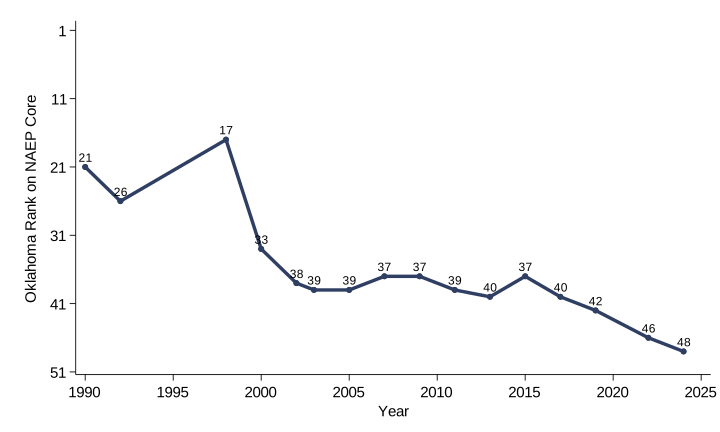
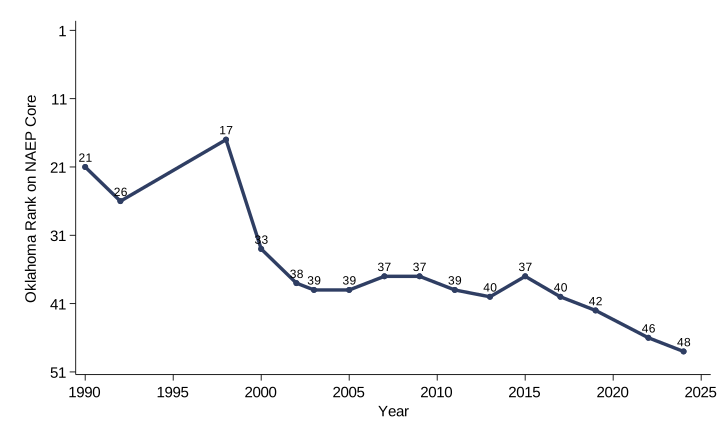
First, Oklahoma’s educational outcomes rank among the worst in the nation. In 2024, Oklahoma ranked 48th nationally on the NAEP Core measure, placing it ahead of only three jurisdictions (see Figure 1). This low standing is consistent across subjects and grades. Oklahoma ranks near the bottom nationally in 4th grade and 8th grade reading and math, indicating consistent, not isolated, weakness.
Second, Oklahoma’s educational outcomes are the worst in the region. Among the 12 states with a university whose athletic teams participate in the Southeastern Conference (SEC), Oklahoma ranks last overall and last or second-to-last on every measure included in the analysis (see Table 1). States with similar demographics and economic profiles—including Mississippi, Louisiana, and Tennessee—substantially outperform Oklahoma on the same NAEP measures.
Third, Oklahoma’s racial/ethnic and socioeconomic groups all perform below average, with the exception of Native American students, who rank highly. With one notable exception, every major student group in the state performs below the national average compared with similar students in other states. Oklahoma’s White, Black, Hispanic, multiracial, and economically advantaged students all rank near the bottom nationally and last or nearly last in the region. The exception is Oklahoma’s Native American student population, which ranks first nationally among states with sufficient data. This pattern indicates that Oklahoma’s overall standing reflects broad underperformance across groups rather than the composition of the student population.
Fourth, Oklahoma’s educational outcomes once ranked above average nationally before falling to their low levels today. This report documents what can only be described as Oklahoma’s “fall to 48th”. In the 1990s, Oklahoma generally ranked at or above the national average on the NAEP Core measure. Since the late 1990s, however, the state’s relative standing has declined steadily. The trend is gradual but persistent, accelerating after 2015. By 2024, Oklahoma had fallen almost to the bottom of the national rankings.
This long-term decline is especially pronounced in reading, where Oklahoma once ranked above the national average but now posts its worst scores—and ranking—on record. Math performance rose through the early 2010s before declining and failing to recover.
Finally, Oklahoma’s decline occurred while some other low-performing states in the region improved. Until 2013, Oklahoma had consistently outperformed Louisiana, Mississippi, and Tennessee. In recent years, however, those states have experienced what some observers have referred to as the “Southern Surge.” Through sustained efforts focused on reading instruction, curriculum alignment, accountability, teacher development, and strategic investment, these states improved their outcomes and rose in the national rankings as Oklahoma fell. Mississippi’s rise is particularly notable; long ranked near the bottom, it now sits in the middle of the national distribution.
The contrast is instructive. Oklahoma’s downward trajectory is not part of a regional pattern. It is a divergence from it.
The findings of this analysis carry important implications.
Claims that Oklahoma’s schools rank poorly are well supported by the nation’s most credible student achievement data. At the same time, history shows that Oklahoma once performed far better than it does today. There is nothing inherent in the state’s geography, economy, or demographics that requires it to rank near the bottom. Other states with similar challenges have reversed course.
Oklahoma’s history and the experiences of neighboring states demonstrate that Oklahoma’s poor educational performance is not inevitable. Improvement is possible through sustained, evidence-based policies.
Oklahoma has mounted comebacks before. The data suggest that there is no reason it cannot do so again.
Author Bio
Adam Tyner is Executive Director of the Oklahoma Center for Education Policy (OCEP) at the University of Oklahoma. He also serves as Executive Editor for the Oklahoma Education Journal.